
Starting with a Pipe
Sentimentality and Smoking

Just recently I came down with a severe illness. Despite my best efforts, it worsened to the point where I was hospitalized for four days. This would not be worth telling, except for one thing: it was affecting my lungs. Every breath was labored, my body demanding more oxygen than it could receive. I had some pretty bad headaches and my legs cramped when I got out of bed. The most important effect was that I could not smoke. Now when I say I was prevented from smoking, I am sure it conjures images of stamped out cigarette butts, yellow stained roofs and teeth, and a nauseating stench that emanates from clothes and people alike. I am here to eradicate such images from your mind. When I say I could not smoke, I mean I could not go through the evening ritual of packing my pipe, reclining on the porch and enjoying a fine blend of tobacco while watching the sun set in the West and stars begin to blaze in the night sky. Notes of chocolate, cherry and vanilla waft through the air, and others begin to join me for a hearty conversation about anything they please. This is smoking and it is a thing near and dear to my heart.

It was on one of these evenings that I began to think of why this activity is a nearly daily thing for me. Why is it that my rosary and pipe are unified? That line of questioning brought me to wondering what sentimentality is and how we as humans are affected by it. As I gripped my pipe between my teeth, the sense grew with every puff that I was on to something. This may seem like an odd sort of transition, but allow me to explain. When I was eighteen, I mail ordered my first corn cob pipe and one and a half ounces of tobacco. This was done without the permission of my parents (although I am sure they found out at some point) and it all had to be hidden from them. Luckily I used to work late, so I could smoke after my evening shifts. During the day, my pipe would be sealed in two ziploc bags (to hide the smell). At night, my grand rebellious action was smoking in the backyard and writing poetry. Afterwards I would brush my teeth vigorously to kill any hint of tobacco on my breath, the pipe would go back in its bags and I would go to bed. Perhaps my parents let this sin go, ensuring I did not pursue greater ones… Regardless, I had a pipe and I used it. I still have that pipe, four years later, and it is one of my favorites. The weight is just right, the char in the bowl provides a subtle undertone to the smoke, it holds just enough tobacco and sits comfortably between my teeth.
These are not the reasons the pipe is so valuable to me, however. These are not reasons that perfectly explain my heartfelt response towards my corn cob pipe. Instead the reason is found in my anecdote above. Sentimentality is a thing that does not dwell neatly in the intellectual. Instead it nestles into the warm, tangled up nest that is the human experience.
The term itself actually comes from a combination of two words: the Old French word sentiment and the Latin sentimentum both meaning “opinion or feeling”. In the middle eighteenth century, the word took on a meaning of “higher feeling or a thought colored by and proceeding from emotion”1.
Drawing from this, we can see what a curious thing sentiment is. We are composite creatures, having both an intellectual soul and an animal, corporeal body. Sentiment is one of the by-products of our creation, a thing that can only exist because we have both emotions and thoughts. The first we have because we are animals (in the broader Aristotilan sense) and the second is because of our rational souls. The classical thinkers such as St. Thomas Aquinas, Aristotle and Plato want to say that a virtuous man influences the lower passion by way of his reason, that is that everything animal (or lower) is in obedience to the reason (the higher). It seems, however, that sentiment works in exactly the opposite direction. Is there room for sentiment in this paradigm? A larger question still, did Adam and Eve have sentiment before they fell into sin?
Let us look further into the thing itself before actually engaging in such questions. Sentiment has emotion as its efficient cause. This is what is meant by “proceeding from emotion” above. What is also important is that because its efficient cause is the emotional side of man, sentiment attaches itself to things not ideas. Objects impress themselves on a person in a way an idea does not. I am not trying to diminish the impact of an idea, of course. Augustine’s response to tolle et lege can not be taken lightly, although this is a consideration for later.
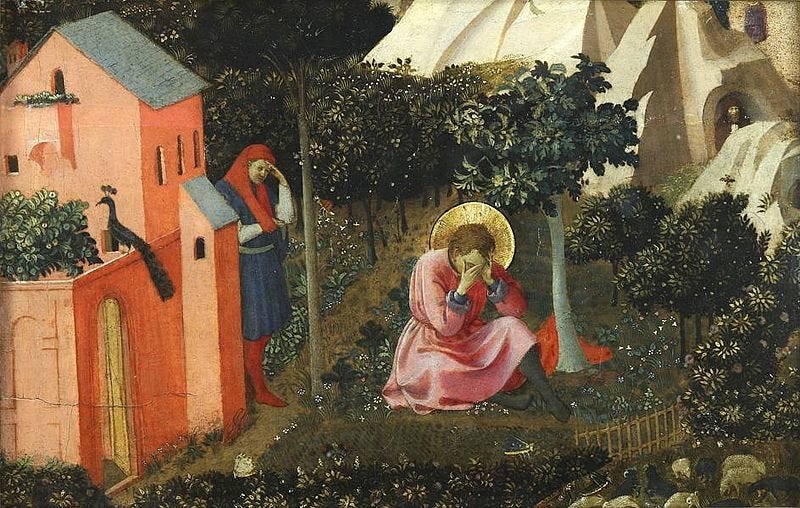
For now, we must return to the task at hand. Who hasn’t been instantly transported to childhood because of a smell, a taste, a sound? Objects that accompany us through powerful times in our lives acquire the same power as these sensory perceptions.
Because of this, it seems that sentimental objects are sacramentals of our experiences. They convey a graceful reminder that we are human, and that means we have a place in physical reality as well as the spiritual one. Someone loves his mug because it held his coffee whenever he was writing his doctoral dissertation. A favorite fountain pen was used to write a love letter for the first time. Adam and Eve love to have lunch under the tree where they shared their first kiss. With every encounter with this individual thing, the feelings come back, and one is invited to reflect, if but for a moment, on how wonderful his life has been. Through the object, he remembers the smile of a lover, the victory of a well constructed argument, the warmth of an embrace.
The paradox that man finds himself in has many unfortunate consequences. He is hungry, sad, and can get sick. It also has many wonderful things that are only possible because he is an intellectual and physical composite. One of these “happy little accidents” is that he can be sentimental. Man is able to form relationships with other people and is invited far in the future to remember them. Once he recognizes this invitation, it is up to him to respond. If he does, there is a depth of memory and wonder that is not possible in any other way.
But how does this apply to me and my pipe? I smoked alone, and it seems I had no sort of community to engage with when I first started. This would be true if I smoked in a vacuum, so to speak. Instead what I did was write and read poetry. This was not good poetry by any stretch of the imagination, but it was an effort in the arts that marked the beginning. Eighteen was an incredibly pivotal time for my life. I could have chosen a good, cozy school where many of my friends were going, or I could challenge myself and truly grow in a college that pursued the Good qua Good. Those nights, with that pipe, solidified my decision. I would go somewhere new, and develop myself as a student in ways that were foreign to me. That pipe, that little piece of corn cob, is still accompanying me through that journey. My pipe forces me to remember where I came from. In its little kernels and crevices I walk through each book, each conversation, each written project that brought me to the intellectual understanding that I have now. It makes me reflect on my time as a budding philosopher and theologian (emphasis on budding) and helps me see how far I’ve come. For this, I love my little pipe.
If you enjoyed this article, please consider saying so:
Have a question or article you would like to see in a future edition? Message me below!
https://www.etymonline.com/search?q=sentiment
Superb. Poetry and smoking is a combination I'd never considered. Thanks for the inspiration.
Thank you Jake for this superb piece of pipe-splaining. Your treatment of sentimentality as possible only in our composite nature is great. I now understand and love my own "sentimental memories much better.